
While an unprecedented heatwave sweeps across Europe, forcing the issue of climate change onto national political agendas as an undeniable reality, and as many of you might be planning a visit to Venice during the summer holidays, let’s continue our exploration of the Art Biennale through the prism of ecology—this time dwelling upon the presentations of the national pavilions.
A purely quantitative overview shows that ecology has become a deeply embedded, recurring theme for this edition of the international exhibition; as over twenty national pavilions have placed environmental crises at the very center of their presentations. This focus is highly symptomatic of a broader, undeniable shift in the global art landscape: ecology has become a white-hot topic—no pun intended.
Instead of adopting a standard, "Top 5 Pavilions Tackling Ecology" format— sacrificing our SEO ranking for the sake of nuance—this article will follow a thematic flow. A qualitative analysis unveils indeed that, beyond the diversity and richness of these pavilions, several commonalities clearly appear, mapping out an urgent collective paradigm shift that reveals the growing, radical potential of art when confronted with a planetary crisis.
NATIONAL PAVILIONS AS FORUMS FOR COLLECTIVE ECOLOGICAL GRIEF
One recurring attitude observable in several of these national pavilions is to find in art a preferred channel to express ecological grief in front of a disappearing, cherished landscape that was once a pillar of the national and geographical identity, or a jewel of local biodiversity.
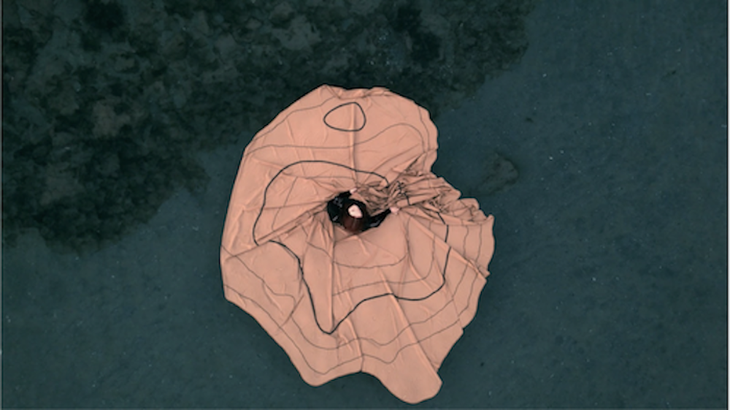
The Uzbekistan pavilion tackling the environmental tragedy of the Aral Sea, which was largely dried up since the 1960s due to aggressive irrigation projects, is a vibrant example. Inspired by the Karakalpak author Allayar Darmenov, who literally began 'writing the Aral Sea back to life' through fantasy fiction, the group exhibition of seven artists proves that mythmaking can become a vital tool for processing profound 'ecological grief' and keeping the memory of a lost ecosystem alive when facing a phenomenon of ecosystem disappearance.
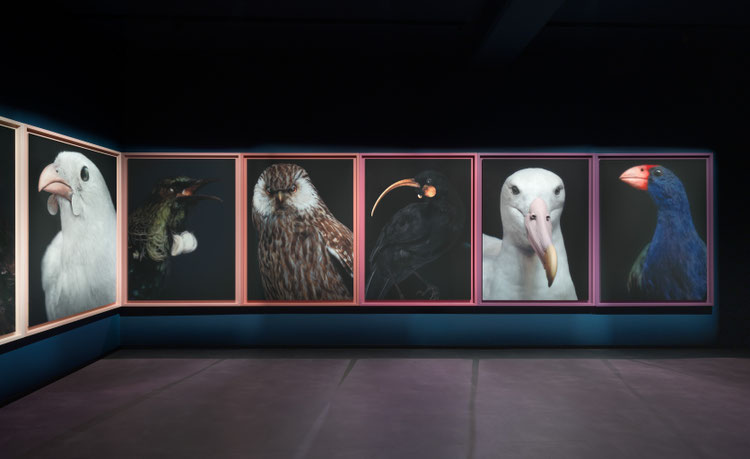
Another striking example is to be found in Fiona Pardington’s large-scale photographs at the New Zealand pavilion, portraying taxidermied birds from critically endangered and entirely extinct native species. Through this series of monumental and charismatic portraits, the photographer is creating a secular pantheon, giving back dignity to these majestic creatures considered as spiritual messengers by the Māori worldview. As stunning as they are unsettling, these large portraits seem to whisper this haunting question: what would happen to us if we are unable to connect with our skies ?
HONORING INDIGENOUS CULTURE AND WORLDVIEWS

Next to the pavilions processing the visible wreckage of global ecocides, another group of nations honors Indigenous worldviews to restore balance with the living world. In From Other Worlds, the Peru Pavilion—exhibiting an Indigenous artist for the first time since the nation began participating in the Venice Biennale—stands as a meaningful testament to this approach. This institutional correction is all the more significant as the country holds one of South America's largest Indigenous populations, with the nation finally recognizing the vital relevance of its ancestral wisdom in front of a fracturing planet. The solo pavilion, presenting Sara Flores, centers around her practice of kené, a sacred visual language generated by the women artists of the Shipibo-Konibo people through the ritual ingestion of native master plants. These intricate geometries, though appearing as abstract patterns to the uninitiated Western eye, actually capture a sacred alliance between the human and non-human worlds—an intersection necessary to operate a truly ecocentric paradigm shift, where the canvas ceases to be a passive landscape to look at, and becomes an energetic, vibrating map to be listened to.
This radical dismantling of the human-nature divide is pushed even further by the Ecuador Pavilion, where the anti-colonial filmmaking collective Tawna, next to the contemporary artist Oscar Santillán, explore ancestral Amazonian knowledge through the lens technology. Dreaming and sexuality are here reframed as "sensitive technologies"—valid biological tools utilized by Amazonian communities to navigate the forest, transmit ecological intelligence, and organize collective care. By merging Andean wisdom systems with AI and 3D modeling, the pavilion allude that protecting the environment is not a detached effort to preserve trees, but a radical requirement to safeguard a single, collective living tissue where the human mind and the rainforest are the same interconnected entity.
FLUIDITY AND DEMATERIALIZATION: THE SONIC SHIFT
Directly following this embrace of ancestral intelligence, the Biennale witnesses a distinct preponderance of dematerialized artistic practices and concepts. The most prominent manifestation of this trend lies in the widespread use of sound either as an active co-participant or as the main protagonist across numerous pavilions from this edition, that we could be easily define as the most sonic biennale in recent history. In Black Seas – Scores for the Sonic Eye at the Romanian Pavilion, Anca Benera & Arnold Estefán swap unreliable visibility for an underwater "sonic eye" composed of sonar data and acoustic scores to navigate the dense, militarized, and anoxic marine archive from the Black Sea. Sound here is deployed as a critical tool for mapping sub-aquatic environmental degradation, presenting the sea not as a passive body of water, but as a living, reacting historical archive that records the political and military violence of the nations surrounding it.
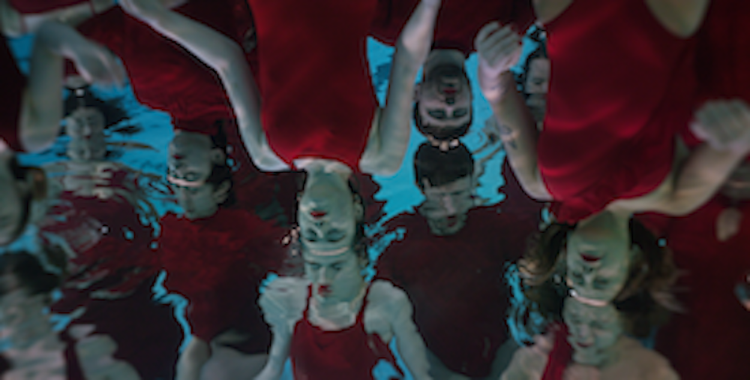
This acoustic shift is also notable at the Polish Pavilion, where deaf artist Daniel Kotowski and playwright Bogna Burska through Liquid Tongues, a two-screen video installation that explores the concept of "Deaf Gain" to reframe deafness as a vital sensory culture rather than a deficit. Uniting a collective of hearing and Deaf performers who physically translate whale echolocalizations into International Sign Language and low-frequency bodily vibrations, the pavilion dismantles the anthropocentric assumption that vocalized human speech is the absolute center of intelligence. By anchoring their project in the legacy of Roger Payne’s landmark 1970 Songs of the Humpback Whale recordings—that originally catalyzed the global anti-whaling movement—the exhibition orchestrates slow, deep listening as a radical form of marine kinship and ecological care.
ECOLOGY AS A VERB: SUSTAINABLE MATERIALS AND INFRASTRUCTURE
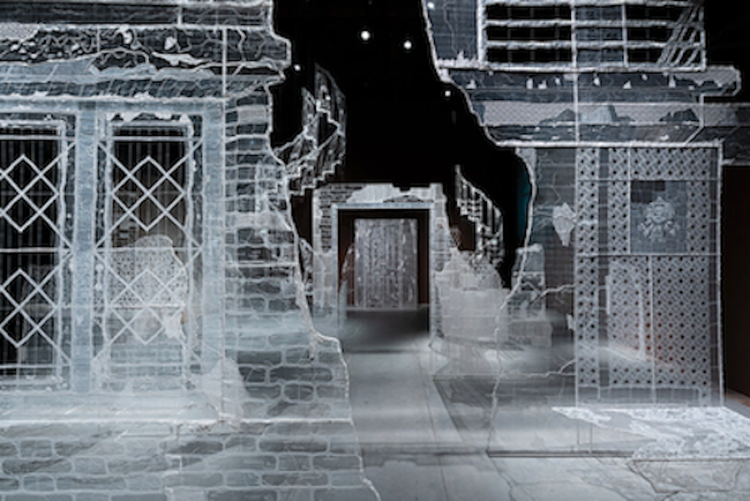
Some national exhibitions are going a step further, moving beyond the presentation of ecological worldviews to incorporate eco-sustainability by embodying it and placing it at the heart of their artistic practices or architectural infrastructure. This is the case of Geographies of Distance: remembering home, a group show presenting the practice of five leading Indian artists curated by Dr. Amin Jaffer at the Indian Pavilion. Deliberately avoiding high-tech or industrial media, the exhibition relies strictly on raw, low-impact vernacular materials—such as soil, bamboo, clay, hand-worked thread, and papier-mâché—that carry millennia of civilizational memory while leaving zero toxic footprints behind. Through these organic material cultures, the featured artists evoke an emotional, deeply felt connection to the idea of home, transforming ancestral craftsmanship into an active, low-carbon blueprint for contemporary environmental care.
At the French pavilion, Comme Saturne from artist Yto Barrada weaves textiles, industrial mechanisms, natural erosion, and historical artifacts to explore political and ecological burnout. Drawing on alternative pedagogies and radical ecology, Barrada transforms the rigid, modern geometry of the pavilion into a living, plural garden. Beyond this artistic direction, the pavilion acts as an interesting Low-Carbon Laboratory. Following an extensive low-carbon roadmap that successfully vaulted the historic 1912 structure from a failing "F" energy rating to a highly efficient "A3" score, the pavilion utilizes smart solar shading, double-glazed skylights, and a high-efficiency HVAC system to drastically curb winter heat loss and summer overheating. Beyond these infrastructural upgrades, the project institutes a strict mandate on structural sobriety by enforcing the reuse of construction materials, championing localized production methods, and deliberately limiting international shipping emissions—proving that contemporary art can only meaningfully speak about the environmental crisis if it radically alters its own modes of production.
Whether through the sacred geometries of kené, the sensitive technologies of Amazonian dreaming, the bodily vibrations of non-human echolocalizations, or the practice of material sobriety, this edition of the Biennale proves that confronting a planetary crisis requires a radical overhaul of both our senses and our systems. Yet, beyond the sensorial and conceptual excitement aroused by the vastness and diversity of these radical worldviews, one crucial question remains suspended: can global cultural systems actually act upon them, or will they merely leave them behind as beautiful, dematerialized ghosts in the Venetian lagoon?
Originally published in Italian on Collezione da Tiffany – See original article
Write a comment