
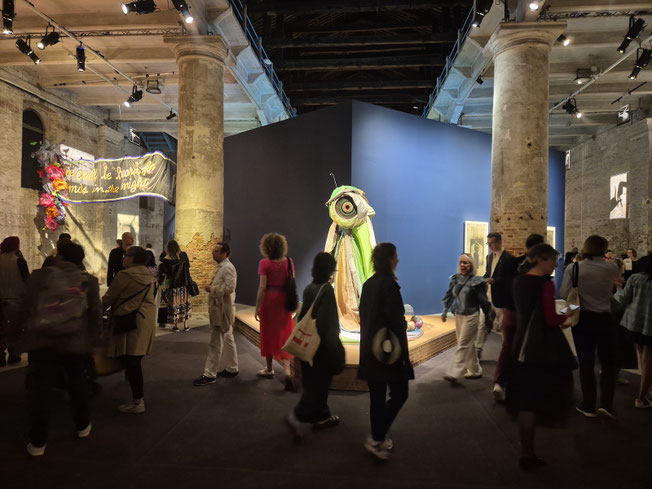
While the scientific community recently reported[1] the breaching of the seventh planetary boundary—ocean acidification—which artistic visions are emerging from the Venice Biennale—a barometer of global contemporary creation—to capture the scope of current ecological imbalances and the ontological challenges they pose?
Given the breadth and diversity of the exhibition, and in harmony with a Biennale that invites the public to slow down and enter a space of listening, this exploration will unfold in three stages. This allows us to navigate the exhibition’s various layers: the main exhibition, the national pavilions, and the collateral events. This first article is dedicated to the main exhibition, curated by Koyo Kouoh.
a new curatorial paradigm
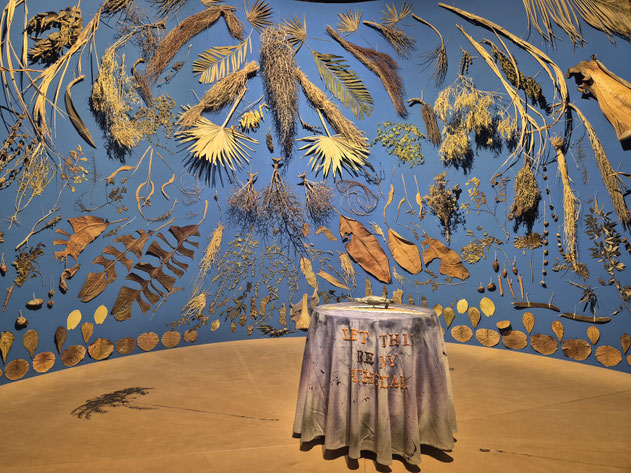
As the first African woman to serve as artistic director of the Venice Art Biennale, Koyo Kouoh introduces a curatorial process that reveals the subversive nature of her exhibition from its very inception. Gathering in Dakar at the RAW Material Company—the cultural center founded by Kouoh in 2008—the curatorial committee conducted the initial phase of artist selection under the protective shade of a mango tree. This process intertwined critical dialogue with botanical and atmospheric phenomena: whenever an artist’s name was spoken, a mango would fall. This recurring occurrence punctuated the flow of discussion, introducing a form of interspecies communication in which the living world seemed to actively participate in the curatorial decision-making. Through this, a new epistemic alliance with the non-human world took shape, clearing the path for a curatorial practice grounded in an ecology of attention—born of an expanded listening that relies on the wisdom of the elements.
Beyond this co-curatorial process, the exhibition’s overarching concept is deeply rooted in botany. The Creole garden—an ecosystem of immense biodiversity blending edible, medicinal, and ornamental plants, but also a space of self-sufficiency and resilience born out of colonial oppression—forms the conceptual and architectural core of In Minor Keys.
What truly sets In Minor Keys apart from recent ecological art practices, however, is the marked shift in perspective it brings to an international event of this scale. Through a strong presence of artists from Africa, its diaspora, and South America, the environmental conversation moves away from a theoretical, crisis-driven Western lens. Instead, it centers voices from regions where devastation, extractivism, and climate inequalities have long been structural conditions—where the climate emergency is not a future threat, but a reality already etched into landscapes, bodies, and collective memories. Rather than merely imagining a “green” future, this Biennale interrogates the invisible costs of the ecological transition. It proposes forms of coexistence grounded in listening, reciprocity, and knowledges marginalized by the modern Western paradigm, transforming ecology from a mere object of representation into a lived experience of relationship with the living world.
In this sense, In Minor Keys builds upon the legacy of the 2024 Biennale, Stranieri Ovunque, curated by Adriano Pedrosa, which placed the Global South, indigenous epistemologies, and diasporic subjectivities at its center. Yet, while the 2024 edition focused on the figure of the “stranger,” Koyo Kouoh’s Biennale shifts our gaze toward a grammar of material and ecological relations—questioning not only who speaks, but the very systems that make life possible, or impossible.
A Silent Carnival of the Living

Among the most poignant works is Big Chief Demond Melancon’s performance, Blessing the Ancestors, a ritual procession in the Giardini rooted in New Orleans’ Black Masking Culture. Wearing his “Jah Defender” costume (2020), the artist traversed the grounds accompanied by members of the Young Seminole Hunters tribe[2]. Through call-and-response and shared recitation, their collective presence transformed the performance into a living act of remembrance and invocation directed at ancestral spirits. Here, the body acts as a threshold: a space where memory, knowledge, and political agency intertwine. Through movement, gesture, and sonic resonance, the performance establishes a profound connection with elemental forces—water, air, fire, and earth—carving out a shared space of resistance, healing, and joy.
While these works explore a sensory reconnection with the living world and its varied temporalities, others shift their focus to physical infrastructure and the hidden costs of such interdependence. This is the case with Alfredo Jaar’s The End of the World, installed in the Arsenale. Cast in an immersive, dazzling, and unsettling red light—a signature of the Chilean artist's visual language—the installation underscores the geopolitical and environmental fallout of mining the minerals essential to digital technologies. At the center of the work, a cube composed of ten strategic raw materials—including cobalt, lithium, coltan, and rare earths—becomes a nexus that condenses global tensions over resource exploitation. The work exposes the paradox of the so-called “green transition,” revealing how the promise of technological sustainability is fundamentally underpinned by intensive extraction and global supply chains marked by environmental devastation and geopolitical conflict.
It is within this field of tension—between what endures, what is extracted, and what disappears—that the Biennale’s discourse ultimately shifts to a different register: that of mourning as a shared condition. Perhaps one of the most poetic, and redemptive, responses is found in Nick Cave’s sculptural series, Two Points in Time at Once. Here, the hybridity of the human body fused with faunal and botanical elements emerges as a vital key to navigating grief. In an era defined by compounding losses—from species extinction to the irreversible fracturing of landscapes—mourning ceases to be an individual burden. Instead, it becomes a collective experience, binding the living into a singular web of relations. Faced with a fracturing world, this radical alliance presents itself not as a mere metaphor, but as a method for cultivating a habitus of disorientation.
Originally published in Italian on Collezione da Tiffany – See original article
[1]Planetary Health Check 2025 del Potsdam Institute for Climate Impact Research (Sakschewski et al., 2025)
[2] In New Orleans’ Black Masking culture (historically referred to as Mardi Gras Indians), organized groups are structured as "tribes." The styling of names like the "Young Seminole Hunters" honors the historic solidarity, shared resistance, and cultural mixing between enslaved African people and Indigenous nations (such as the Seminole) who offered them refuge in the American South.
Write a comment